Diné Bá Álchíní Yił Ádaaní -- Navajo Family Voices
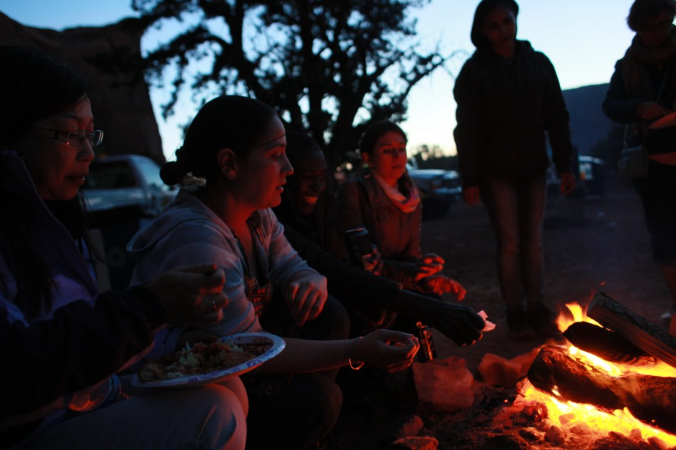
Family is raised together around the fire, t’ááłá’ k’ǫ‘diltłi’dóó biyaadahoo’á’ígíí
Diné Bá Álchíní Yił Ádaaní (Navajo Family Voices) is the Family Voices Affiliate Organization (FVAO) and the Family-to-Family Health Information Center (F2FHIC) for the Shiprock, Fort Defiance and Eastern Navajo agencies. As a federally recognized health information hub, we are a peer-led organization of families who have navigated the unique healthcare infrastructure of the Navajo Nation for generations. We operate as a program of Indian Country Grassroots Support, and work towards health parity throughout the region where we live and serve. Our services are available to all families residing within our service area regardless of race, color, or national origin.
Our goal is to provide sustainable, holistic information and support to enable the self-advocacy and navigation of families of children and youth with extra healthcare needs (CYSHCN), ensuring the long-term wellness of youth and families within our service area.
Our team possesses the specialized lived experience required to manage limited healthcare resources and bridge the gap created by diminishing traditional wellness knowledge. Supporting families of children and youth with extra healthcare needs (CYSHCN) in a rural tribal setting requires a specific mastery of cross-jurisdictional health systems. Navigating these complex rural healthcare landscapes presents significant logistical, planning, and knowledge challenges. Our rural geography requires specialized, community-informed problem-solving that addresses the specific historical and regional needs of the Navajo Nation.
Áłchíní hózhóójí bá Nahat’á — Planning for Our Kids in a Blessing Manner--is our primary focus.
Diné familial traditions, maintained for generations, reflect the wisdom passed down through time immemorial. Roles such as mothers, fathers, siblings, and grandparents involve what the West may call extended family (aunts, uncles and cousins). A family is all who are raised together around the fire, t’ááłá’ k’ǫ‘diltłi’dóó biyaadahoo’á’ígíí, which are called the immediate family. The roles carry specific cultural meanings essential to child protection and wellness. When we fulfill these traditional matrilineal roles, we share the specialized knowledge necessary for the health of our children. This family structure is the foundation of k'é (connections) and ajoobá (kindness), which are vital social determinants of health and wellness for each other and especially for our youth.
The healthcare infrastructure within the Shiprock, Fort Defiance and Eastern Navajo Service Units is uniquely complex, involving the intersection of state, federal, and tribal jurisdictional public healthcare systems. There is no private healthcare on the reservation.
27,000 sq. miles across three states. The Navajo Nation is more than 27,000 sq. miles, or the size of Portugal or West Virginia. The reservation spans portions of Arizona, New Mexico, and Utah. Each state maintains distinct resource frameworks, which must be integrated with tribal and community-based services. Facilitating an integrated understanding of these resources is fundamental to Nahat’á.
Nahat’á -- Planning is a core tenet of Diné traditional knowledge.
Nahat’á, for Diné families, involves living in connection and right relations with all beings and Mother Earth. The holistic processes to achieve harmony and balance (hózhó) among all our relatives is Diné k’ehgo nitsáhákees. The traditional planning model that follows the seasons, the path of the sun, and being present and restorative in the great Cosmos of all things, is an essential cultural observance that includes all families, providers, and traditional knowledge keepers in developing collaborative health solutions.
Effective wellness planning for children with extra healthcare needs requires cultural and linguistic competency from service professionals and the direct involvement of the children themselves. Áłchíní hózhóójí bá Nahat'á reinforces a historically-grounded foundation for wellness that has supported tribal families for generations, ensuring that modern healthcare delivery respects the cultural continuity of the Navajo people.
This program is supported by the Health Resources and Services Administration (HRSA) of the U.S. Department of Health and Human Services (DHHS) as part of an award of $96,750 beginning in 2018. We are a small program, with other program costs further financed from state agencies and non-governmental sources. The contents of this website are those of the authors and do not necessarily represent the official views or non-endorsement by HRSA, DHHS or the US Government. For more information please visit HRSA.gov.